
Financial Accounting in Georgia: A Practical Guide for Businesses
Financial accounting is the system that turns your day-to-day transactions into the formal statements that banks, investors, tax authorities, and regulators rely on to judge your business. If you operate a company in Georgia – whether you’re a foreign founder who just registered an LLC in Tbilisi or a local SME owner – getting financial accounting right is not optional. Georgian law requires registered companies to keep proper accounting records and file annual financial statements, and the rules that apply to you depend on your entity’s size.
This guide explains what financial accounting actually involves in the Georgian context: the standards you must follow, who is obligated to report, how it differs from tax accounting, and the mistakes that catch foreign-owned businesses off guard.
What Financial Accounting Means for a Business in Georgia
Financial accounting is the process of recording, classifying, and summarizing a company’s transactions into standardized financial statements – primarily the balance sheet, the income statement, the cash flow statement, and the statement of changes in equity. Its purpose is external: it produces a true and fair picture of the company’s financial position for people outside day-to-day operations.
In Georgia, that external audience is concrete. It includes the Service for Accounting, Reporting and Auditing Supervision (SARAS) for those entities required to publish statements, the Revenue Service for tax purposes, plus banks assessing loan applications and investors performing due diligence. Financial accounting is the common language all of them read, which is why the framework you use matters as much as the numbers themselves.
Financial Accounting vs Tax Accounting in Georgia
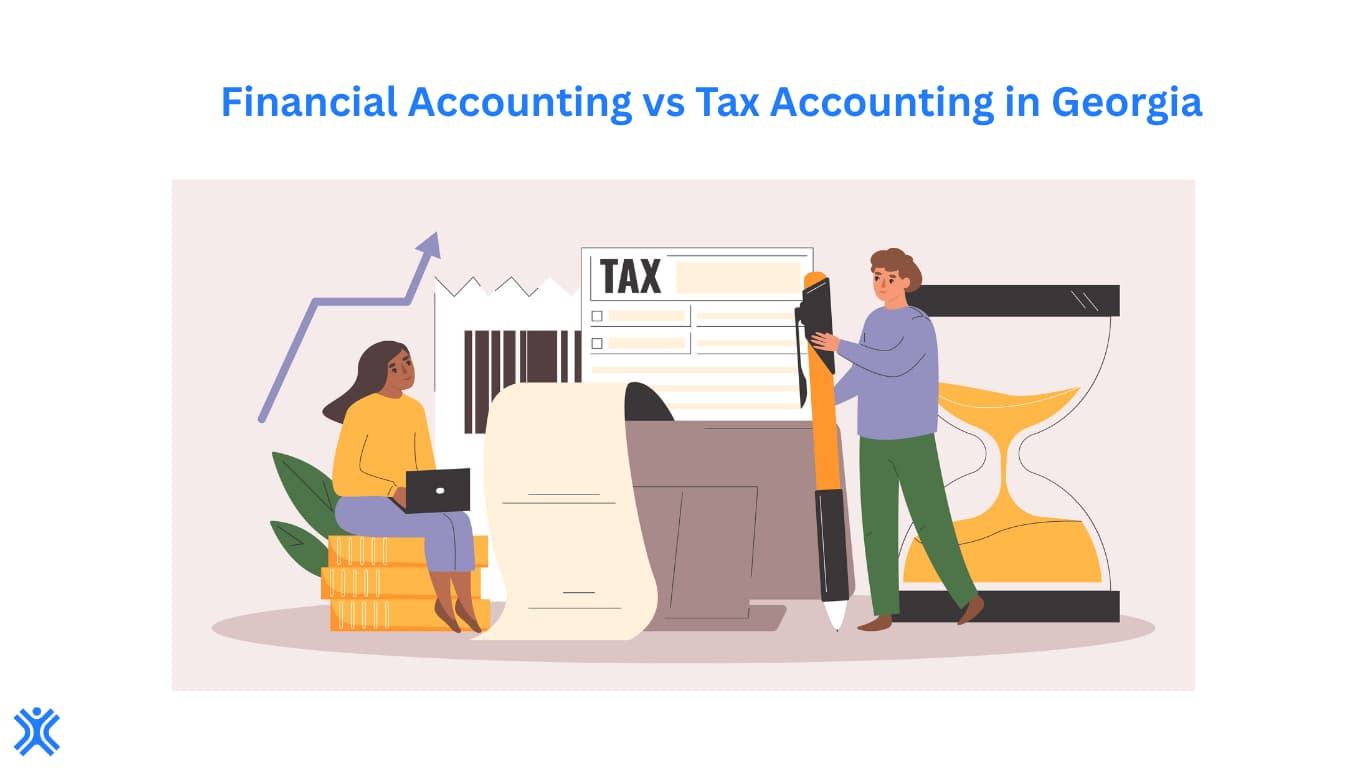
Financial accounting and tax accounting are two separate systems in Georgia, and confusing them is one of the most common errors foreign business owners make. They serve different masters, follow different rules, and rarely produce the same numbers.
Financial accounting follows international reporting standards (IFRS or IFRS for SMEs) and answers to SARAS and external stakeholders. Tax accounting follows the Georgian Tax Code, is administered by the Revenue Service through the rs.ge portal, and exists to calculate what you owe. Georgia’s corporate income tax uses the so-called “Estonian model” – profit is taxed at 15% only when it is distributed (for example, as dividends), not while it is reinvested in the business. Your financial statements, by contrast, recognize profit as it is earned regardless of distribution. A profitable company can therefore show retained earnings in its financial accounts while owing no corporate income tax for the period. Both pictures are correct; they’re just answering different questions.
Financial Accounting Standards in Georgia: IFRS and IFRS for SMEs
Financial accounting standards in Georgia are set by the Law on Accounting, Reporting and Auditing (No. 5386, adopted in 2016) and supervised by SARAS. Which standard applies to your company depends on the size category it falls into, based on its total assets, annual revenue, and number of employees.
The framework breaks down as follows:
- Public interest entities (PIEs) and large (first category) entities must apply full IFRS as issued by the IASB.
- Medium (second category) and small (third category) entities apply IFRS for SMEs, a lighter international standard, though they may voluntarily opt up to full IFRS.
- Micro (fourth category) entities apply the simplified national standard set by SARAS, and may also opt up to a higher standard.
Applying the wrong standard is not a cosmetic issue. Using the simplified micro standard when your size requires IFRS for SMEs produces statements that fail the legal requirement – a compliance gap that auditors, banks, and the Revenue Service can identify. If you are unsure which category your company belongs to, confirming it should be the first thing you do, because every downstream decision in your financial accounting depends on it.
Who Must Keep Financial Accounting Records in Georgia
Financial accounting records are mandatory for every company registered in Georgia. There is no “too small to bother” exemption from bookkeeping itself – the obligation to maintain accounts applies broadly, even if your public reporting and audit obligations scale with size.
What scales is the depth of the requirement. Larger entities and PIEs must prepare full IFRS statements, undergo statutory audit, and publish their reports through the SARAS reporting portal. Smaller entities have lighter reporting and, in many cases, no mandatory external audit. The practical takeaway: every Georgian company needs ongoing financial accounting; only the reporting, audit, and publication layers depend on your category. Treating bookkeeping as something you can “catch up on at year-end” is where most compliance problems begin.
Financial Accounting for Foreign Founders and Expat-Owned Businesses in Georgia
Financial accounting for foreign founders carries a few extra considerations that locals rarely think about. Georgia is one of the easiest jurisdictions in the region to enter – a foreign national can register an Individual Entrepreneur (IE) or an LLC without Georgian residency or a local partner – but ease of entry does not mean ease of compliance.
Two structures dominate for newcomers, and they have very different accounting profiles:
- Individual Entrepreneur with Small Business Status (SBS): taxed at just 1% of gross turnover up to 500,000 GEL annually (3% on the excess). Popular with freelancers, consultants, and digital nomads, and keeps tax-side accounting extremely simple. Note that certain professional activities are excluded from SBS, and 2026 brought new rules – including monthly declaration obligations even at zero turnover, and new work-permit and residence requirements for foreigners carrying out paid activity in Georgia.
- Micro Business Status: 0% income tax on gross turnover up to 30,000 GEL annually, available to qualifying individuals.
- LLC (the standard company): subject to the 15% distributed-profit corporate tax, full financial accounting obligations under IFRS for SMEs (or full IFRS by size), and SARAS reporting where applicable.
Financial accounting choices should be made before you register, not after, because your structure determines your standard, your reporting burden, and your effective tax rate for years. A 1% IE and an LLC are not interchangeable once you’ve built revenue around one of them.
The Financial Accounting Cycle: From Transaction to Financial Statements
The financial accounting cycle is the repeatable monthly and annual rhythm that keeps your records audit-ready instead of a year-end scramble. Whether handled in-house or outsourced, it follows the same logic:
- Capture every transaction with supporting documentation (invoices, contracts, bank statements, receipts).
- Record entries in the general ledger using double-entry bookkeeping.
- Reconcile ledger balances against bank and supplier records each month.
- Adjust for accruals, depreciation, provisions, and currency revaluation (relevant for businesses invoicing in foreign currency).
- Report by compiling the balance sheet, income statement, cash flow statement, and equity statement.
- File with SARAS where required, and align the tax-side figures for the Revenue Service.
Foreign-owned companies trip most often on steps 3 and 4 – multi-currency reconciliation and period-end adjustments – because invoices in USD or EUR must be translated into GEL, the functional and reporting currency, under specific rules.
Common Financial Accounting Mistakes to Avoid in Georgia
Financial accounting mistakes in Georgia tend to repeat across foreign-owned businesses, and almost all of them are preventable with the right process:
- Treating financial and tax accounting as one number. They diverge by design; reconciling them is the work.
- Applying the wrong reporting standard for the entity’s size category.
- Letting documentation slip. Georgian compliance is document-driven; a transaction without a supporting invoice or contract is a problem waiting for an audit.
- Mishandling foreign-currency invoicing, producing distorted revenue and FX gains/losses.
- Missing SARAS or Revenue Service deadlines, which trigger penalties that compound.
- Outgrowing a tax regime unnoticed – for example, crossing the 500,000 GEL SBS threshold mid-year without a plan.
Outsourcing Financial Accounting in Georgia
Financial accounting is rarely the best use of a founder’s time, and for most small and mid-sized companies in Georgia, outsourcing it is the cleaner decision. An in-house accountant makes sense once volume and complexity justify a full salary; below that point, an outsourced provider gives you the same compliance coverage – bookkeeping, reporting, standard selection, SARAS filing, and tax alignment – without the fixed cost, the hiring risk, or the knowledge gap when one person leaves.
The real value of a good provider is not data entry; it’s judgment: choosing the right standard for your category, structuring your books so they hold up under audit, keeping you on the correct tax regime as you grow, and translating Georgian compliance for an international owner who doesn’t read the Tax Code in Georgian.
That’s exactly where Countman works. We handle financial accounting end to end for businesses operating in Georgia – from day-one structure decisions to monthly bookkeeping, IFRS and IFRS for SMEs reporting, SARAS filing, and tax compliance – so foreign founders and local companies can focus on the business instead of the bureaucracy.
Talk to Countman about your financial accounting – book a free consultation and we’ll map your obligations to your entity in one call.


